The $29.95 “Surprise” Fee
I was a loyal Payoneer fan for years after switching from PayPal.
However, a couple of years ago, I made the sudden decision to stop using Payoneer and return to PayPal as my primary tool.
The main reason? A $29.95 annual account fee that Payoneer now levies on accounts that receive less than $2,000 USD in a 12-month period.
For a blogger or freelancer starting out, this fee can wipe out a significant chunk of your early earnings. Because some companies, like AdSense and ezoic, also offer direct account transfers without the need for these two, and one may fall short of the $2000 USD/year requirement.
| Feature | PayPal (Global) | Payoneer (Global) |
| Annual Fee | $0 | $29.95 (If <$2,000 received/yr) |
| Currency Markup | 3.0% – 4.0% | 2.0% |
| Withdrawal Speed | 3–5 Days | < 24 Hours |
| USA Tax | Easy 1099-K (over $20k) | Manual Reporting |
| Best For | Low volume / Security | High volume / Low fees |
PayPal and Payoneer are both online financial services companies that facilitate money transfers worldwide.
- PayPal was founded in early 1998 by the PayPal Mafia (including Peter Thiel and Elon Musk) and built a large customer base through its professional, transparent conduct.
- Payoneer launched in 2005 but quickly gained many customers thanks to its innovative transaction methods, fast cash withdrawals, and comparatively low fees.
Those with experience would have chosen one of the two for their regular business transactions.
But for those new to at least one of the platforms, this guide will help you decide.
Deep Dive into PayPal (The Security Beast)
It is a well-known company with an excellent reputation for safety and security.
For USA users, the IRS threshold for 1099-K reporting has reverted to $20,000 and 200 transactions.
Pros:
- High reliability with beautiful UI (user interface)
- Many merchants use PayPal to accept customer payments.
- Ability to make complaints and even reject payments.
- Avoid disclosing credit card information, as many merchants accept payments on their sites via PayPal.
- Automatic withdrawal of payments to local banks.
- Automatic currency conversion before withdrawal to local banks.
- Clear-cut details regarding transactions and conversions are displayed on the account.
Cons of PayPal
- Higher hidden costs in currency conversion
- Slower bank transfers comparatively. At times, one has to wait 5 to 7 days to see the money in the account.
- There might be a few countries that are exempt from their services.
Why PayPal Wins for the “Small” User
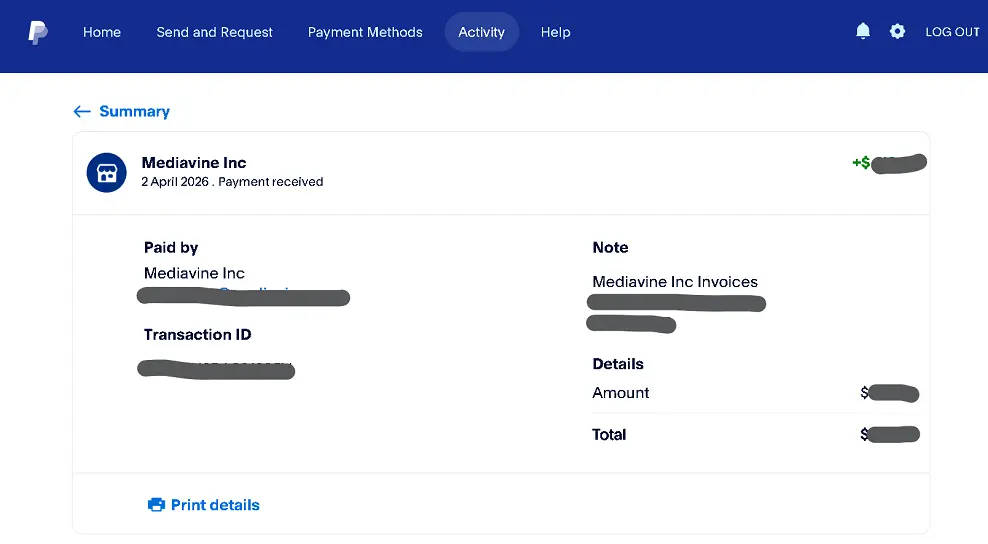
If you are just starting your digital journey—perhaps getting your first payments from Ezoic or Mediavine—PayPal is the safer harbor.
- No Inactivity Penalty: You can leave $10 in your account for three years, and it will still be $10.
- Universal Acceptance: From hosting providers like NameHero to digital tools, PayPal is the “Gold Standard” for payments.
- USA Buyer Protection: For my readers in the USA, PayPal’s dispute resolution is far superior if a merchant fails to deliver.
Deep Dive into Payoneer (The Speed King)
Though both are great partners to engage with, I preferred Payoneer for some of its exceptional and additional services, like
Virtual Receiving Accounts (USD, EUR, GBP). This is huge for people without a country-specific bank account.
This includes an account with the number, bank name, and Routing number in order to receive payments, which is helpful for worldwide sales.

For example, if you are an Amazon affiliate and generate sales in different Amazon markets, such as the UK, Japan, France, Canada, and Australia, you can create a virtual receiving account for each country and have Payoneer deposit the funds into your local bank account.
Lower markup fee:
For those earning over $5,000/year, Payoneer’s 2% markup is lower than PayPal’s, saving more money.
PayPal vs. Payoneer: 2026 Breakdown for Freelancers
| Annual Earnings | PayPal Total Fees (Est. 7%) | Payoneer Total Fees (Est. 3% + $30 Fee) | Better Choice? |
| $500 | $35 | $45 | PayPal |
| $1,000 | $70 | $60 | Payoneer |
| $5,000 | $350 | $180 | Payoneer |
Thus, it is gaining widespread use, as many ad networks and online agents have begun using it alongside PayPal.
Pros.
- Faster transactions into local banks. For most, within 24 hours.
- Low transaction fees are charged.
- The high currency conversion rates for each dollar or euro received compared to PayPal.
Cons
- Annoying inactivity fee of $29.95/year if transactions are less than 2,000 USD.
- Strict document verification.
- Some big merchants avoid using it for payments.
- Restricted in some countries.
Global Regional Breakdown
While the annual fee is a global concern, your choice should also depend on your local banking system and tax laws. Here is how the two giants compare across key markets:
1. USA: The “Tax & Trust” Market
For users in the United States, the decision often comes down to IRS compliance.
- The 2026 Tax Update: The IRS has officially reverted the 1099-K reporting threshold to $20,000 and 200 transactions. This is a major win for casual sellers and side-hustlers who were worried about the $600 limit.
- Why PayPal Wins: PayPal handles this reporting automatically. For most Americans, the peace of mind provided by Buyer/Seller Protection and the easier tax filing outweigh the slightly higher fees.
- Payoneer Use-Case: Recommended only for US businesses that need to pay international contractors in their local currencies (e.g., PHP or INR) without high wire fees.
2. India: The “FIRA” Factor
In India, receiving foreign currency is strictly regulated by the RBI.
- Payoneer’s Killer Feature: They provide an Automated Digital FIRA (Foreign Inward Remittance Advice). This document is essential for proving your income is from legal exports/services and for claiming GST zero-rating. On PayPal, getting a FIRC/FIRA is often a manual, paid, and slow process.
- Mandatory Auto-Withdrawal: Both platforms now auto-withdraw funds to your Indian bank account daily. You cannot keep a USD balance in either.
3. Philippines: The “GCash” Connection
The Philippines has seen a massive surge in freelance volume, and the “last mile” of the payment is what matters most.
- Payoneer + GCash: This is the “Gold Standard” in 2026. Payoneer integrates directly with GCash, allowing for instant transfers with better exchange rates than traditional bank withdrawals.
- The Verdict: If you are a Filipino freelancer, Payoneer’s speed and GCash integration usually justify the $29.95 fee, provided you earn more than $2,000 a year.
4. United Kingdom: Local Receiving Accounts
- GBP Virtual Accounts: Payoneer provides a UK Sort Code and Account Number. If you are a UK resident working for US companies, you can receive USD and convert it to GBP at a flat 2% markup.
- PayPal’s “Hidden” Cost: PayPal often forces a conversion at a 3-4% markup before the money even hits your UK balance. For a £5,000 project, Payoneer could save you over £100.
5. Indonesia: The 2026 Expansion
- Local Marketplace Collection: In early 2026, Payoneer expanded its local collection capabilities in Indonesia. You can now collect funds directly from local marketplaces and Indonesian businesses faster and more cost-effectively.
- The Shift: This makes Payoneer a powerful tool for Indonesian e-commerce sellers expanding into international markets such as Amazon or Shopee.
6. Brazil: The Tech Hub Advantage
- USD to BRL: Brazilian developers and designers often prefer Payoneer because it provides greater transparency for Brazilian Real (BRL) conversions.
- Integration: While PayPal is common for domestic Brazilian purchases, Payoneer is the preferred “inflow” channel for high-paying US tech contracts common in Brazil’s growing freelance scene.
Summary of Regional Winners
| Region | Winner | Primary Reason |
| USA | PayPal | Tax simplicity (1099-K) and Buyer Protection. |
| India | Payoneer | Automated Digital FIRA and lower FX fees. |
| Philippines | Payoneer | Direct GCash integration and instant speed. |
| UK / Europe | Payoneer | Local currency receiving accounts (Sort Code/IBAN). |
| Brazil / Indonesia | Payoneer | Local collection infrastructure and better BRL/IDR rates. |
Final Verdict from my personal experience
- Choose PayPal if you are a casual blogger, a buyer, or based in the USA, and prioritize security over fee-savings.
- Choose Payoneer if you are a high-volume freelancer ($2k+/year) or live in India/Philippines and need the fastest local withdrawals.
Once your funds arrive in your local account from PayPal or Payoneer, the next step is to make that money work for you. For my readers in the USA, I personally recommend moving those earnings into a high-yield savings account (HYSA). In 2026, CIT Bank remains one of the top choices for freelancers due to its Platinum Savings account, which currently offers a highly competitive APY for balances over $5,000.
Thank’s for your article.
I’m paypal longtime user, but i have so many problem with french paypal.
They blocked my account for 2 months without giving me any explanation and then reopened it.
As I receive payments from internet, I really suffered a lot, and had to live with very little during this period, I really hate them for that but had no other choice.
I had sent them many polite messages to ask for an explanation that went unanswered.
There is no support on the French paypal, it’s crazy!
But I then opened a paypal Asia account and there they are much more efficient, the support answers the question and I am not obliged to recreate a password each time I want to connect like with paypal France.
Finally I just opened a payoneer account, as I receive money from my websites affiliates program, and I have a Transferwise account, both my affiliate programs and Transferwise work with Payoneer, so it will save me money, time and simplify my work!