NameHero is a professional web hosting and domain registration company.
I run 5 WordPress sites and used to host them on wpx.net (another premium host), then came across NameHero and switched to them.
I moved from WPX because, while they are good, NameHero offers nearly identical performance with LiteSpeed Enterprise at about 1/4 the cost when you lock in their 3-year deal.
And I have found this hosting to be simple, effective, and better for site performance.
Namehero is an American-owned and operated company located in Kansas City, Missouri.
In the world of making money online (MMO), every millisecond your site takes to load is a lost cent in ad revenue.
And NameHero, with its fast performance, can help you save this revenue.
| Feature | NameHero | Hostinger | Cloudways | Bluehost | SiteGround |
| Server Architecture | Private Cloud | Shared Hosting | Managed Cloud | Shared Hosting | Shared Hosting |
| Technology | LiteSpeed Ent. | LiteSpeed | Nginx/Apache | Apache | Nginx |
| Storage Type | Enterprise NVMe | NVMe (High plans) | NVMe / SSD | SATA SSD | SATA SSD |
| US Data Center | Kansas City (Underground) | Multiple | Multiple (Vultr/DO) | Utah | Multiple |
| Free Email | Yes (Unlimited) | Yes | No (Paid Extra) | Yes | Yes |
| Site Migration | Free (Expert) | Free (Automated) | Paid / Plugin | Migration tool | Migration plugin |
| Best For | Niche Site Scaling | Absolute Budget | High-End Devs | Total Beginners | Large Budgets |
1. The Performance Edge: LiteSpeed + NVMe Explained
Most budget hosts use SATA SSDs and Apache servers.
NameHero is different as it has
- LiteSpeed Enterprise: This replaces Apache and offers built-in server-level caching.
- NVMe Storage: Their US data centers (Kansas City, Phoenix) now use NVMe, which is up to 3x faster than standard SSDs.
- TTFB (Time to First Byte): My recent tests show a TTFB of under 200ms for US visitors—crucial for high-paying USA traffic.
2. NameHero vs. Hostinger: Why “Private Cloud” Matters
Further hosts, like Hostinger, have strict restrictions, so even updating WordPress plugins can sometimes put your site offline.
Perhaps this is due to their use of custom hPanel. NameHero, on the other hand, uses CloudLinux, which ensures that if one site on the server spikes in traffic, it won’t bring down your site.
Furthermore, their ‘Turbo’ feature gives you more PHP Workers, allowing your site to handle more simultaneous visitors without slowing down.
Such issues won’t occur with NameHero if the site is well-optimized with server-level cache that the support personnel can help with.
3. NameHero Hosting Review: Plan Comparison
| NameHero Plans | Best For | Key Specs |
|---|---|---|
| Starter Cloud / WordPress | New niche or personal sites (10k visits/month) | 1 Website, 1GB RAM, unlimited NVMe |
| Plus Cloud / WordPress | For average-sized websites | 7 Website, 2 GB RAM |
| Turbo Cloud / WordPress | Established sites | Unlimited Sites, 3 GB RAM, Free domain |
| Business Cloud / WordPress | High-traffic E-commerce | Unlimited Sites, 4GB RAM, Free domain. |
4. Hosting Panel
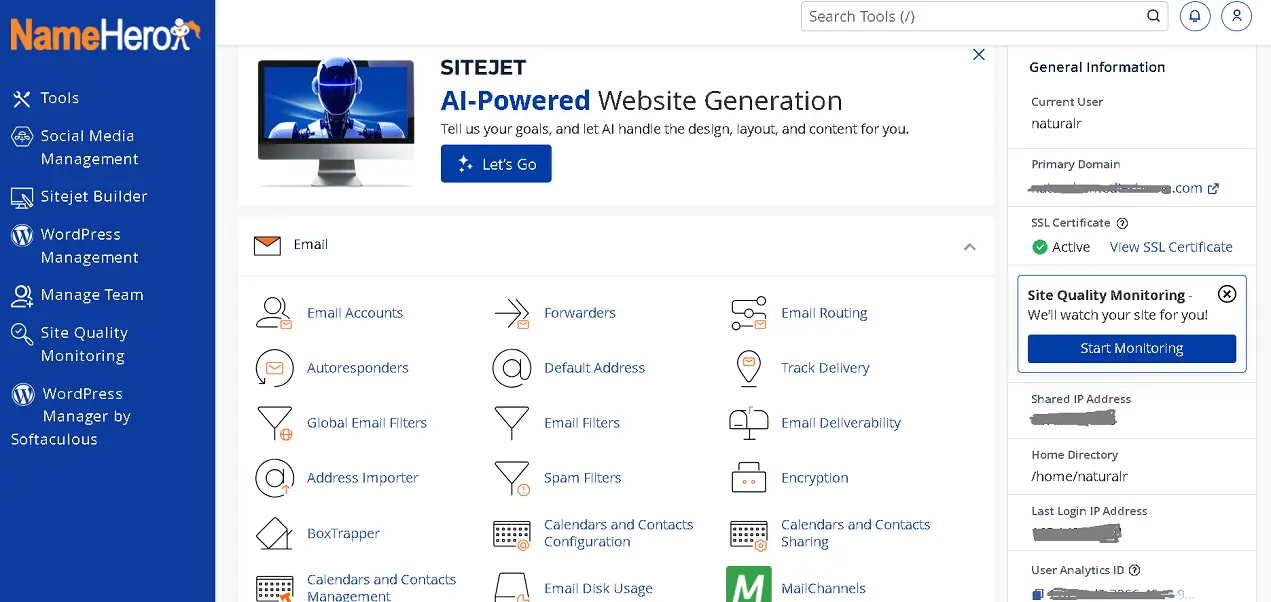
- You will find a normal cPanel-type panel with Nameero.
- But it is also an AI website builder that lets you build sites from scratch.
- The AI HeroBuilder actually generates your site structure and content based on a few prompts.
- It’s built on WordPress, so you aren’t ‘locked in’ like you are with Wix or Squarespace.
5. CDN with free QUIC.CLOUD
- NameHero has an interesting setup regarding CDN.
- Some hosts provide their own free CDN or free Cloudflare integration, while premium hosts offer enterprise Cloudflare plans.
- But NameHero offers paid QUIC.cloud plans with 10 GB of CDN per domain, hosted with them and integrated with LiteSpeed cache.
- My high-traffic site was struggling with an INP (Interaction to Next Paint) of 1.27 sec, which is well above the recommended less than 200ms.
- Upon using QUIC with LiteSpeed cloud integration, the INP dropped to 45 ms, which was surprising.
- Thus, my site’s core web vitals improved a lot, even better than I saw on Bigscoots hosting.
6. Pros & Cons for Users
Pros:
- Free Migrations: They move your site from another host to NameHero for free (a huge time-saver).
- Support: One can avail 24/7 support through live chat or email in case of issues.
- Imunify360: Built-in security means you don’t need heavy security plugins.
- Scaling: It’s “Cloud” hosting, so you can upgrade resources as your traffic grows without downtime.
Cons:
- Renewal Price: The initial 75% discount is great, but renewals are at full price.
- Tip: Buy the 3-year plan upfront to lock in the ₹200-₹300/mo rate.
- Inodes Limits: The Starter plan has a 250k inode limit. If you have thousands of small images, you’ll need the Turbo plan.
7. The Big Comparison: NameHero vs. The Market Leaders
NameHero vs. Hostinger: The Battle of LiteSpeed Titans
This is the most common comparison for 2026. While both use LiteSpeed technology, they serve different user types.
Server Architecture: * Hostinger uses a traditional shared hosting environment. While fast, your site is more vulnerable to “bad neighbors” who use too many resources on the same server.
- NameHero uses a Private Cloud setup. Every account is isolated with its own dedicated RAM and CPU. This is why NameHero stays stable even when other sites on the server have traffic spikes.
Storage Speed: Hostinger uses standard SSDs on its cheaper plans.
- NameHero offers NVMe storage on almost all plans (US Data centers), which is significantly faster at handling large databases (essential for WordPress).
Control Panel: Hostinger uses its custom hPanel. It’s clean but can be restrictive for advanced users.
- NameHero uses cPanel, the industry standard. It’s better for those who want full control over their files and security.
The Verdict: If you want the absolute cheapest price, go with Hostinger. But if you want better stability for a growing niche site targeting the USA, NameHero is the clear winner.
NameHero vs. Cloudways: Performance vs. Simplicity
Many RIF users consider Cloudways for “pro” performance, but NameHero offers a more “all-in-one” experience.
Ease of Use: Cloudways is a “managed platform.” You choose a server provider (like DigitalOcean or Vultr) and manage it yourself. It does not include email or domain registration.
- NameHero is a “one-stop shop.” You get your domain, high-speed hosting, and unlimited business email all in one dashboard.
The “Hidden” Costs: With Cloudways, you often have to pay extra for email hosting (like Rackspace or Google Workspace) and a separate CDN.
- NameHero includes free email and a built-in LiteSpeed Cache/QUIC.cloud integration that matches Cloudways’ speed for half the price.
The Verdict: Cloudways is great for developers, but for bloggers and niche site owners, NameHero offers the same “Cloud” speed with much less technical headache.
NameHero vs. Bluehost: Why Technical Specs Matter
Bluehost is often recommended by big affiliates, but technical users know it lags behind NameHero.
Technology: Bluehost still relies heavily on older Apache server tech.
- NameHero uses LiteSpeed Enterprise, which is proven to handle 2x to 3x more traffic than Apache while using fewer resources.
Support & Migration: Bluehost often charges for site migrations or only migrates “qualified” sites.
- NameHero offers free professional migrations. When I moved my 5 sites (including Studyread), their team handled the technical move for me at no extra cost.
The Verdict: Never choose Bluehost over NameHero if you care about Google Core Web Vitals. NameHero’s NVMe drives and LiteSpeed caching will give you an instant SEO boost.
NameHero vs. SiteGround: Dealing with the Renewal Shock.
SiteGround is famous for its speed, but its pricing model is difficult for niche site owners to sustain.
Pricing: SiteGround offers a low introductory price, but renewals can jump to $25- $40/month.
- NameHero is more transparent. While prices do go up at renewal, they remain much more affordable for a mid-tier niche site.
Resource Limits: SiteGround is very strict with “CPU executions.” If your site gets a small viral hit, they may temporarily shut you down.
- NameHero’s Cloud structure is more forgiving. Instead of shutting you down, it handles traffic spikes more gracefully thanks to isolated resource allocation.
The Verdict: SiteGround is a premium “boutique” host. NameHero is the “workhorse” host—it offers similar premium speeds with greater flexibility and better long-term pricing.
8. Final Verdict: Should You Buy It?
If your goal is to build a high-speed niche site targeting the US market, this is the best value-for-money host in 2026.
The integration of QUIC.cloud CDN and LiteSpeed makes it faster than almost any other host in the $3-$6/month range.
I had been hosting my sites on wpx.net for 4 years previously and moved here, finding it much more economical and with better support.